Written on Thursday, January 19, 2006
I am just getting ready for my Samoan adventure... for those of you who don't know, I'm studying abroad in Samoa for the next few months.
I am leaving Chapman EARLY tomorrow and driving up to my hometown for a few days before flying to Oahu, Hawaii for orientation, which will take a week. Next Sunday (the 29th) I will fly from Hawaii to American Samoa, and then to Western Samoa. Over the course of the next few months I will be immersed in the Samoan culture and unlike other study abroad programs, will not be "taking classes at another university in another country." I am going through the program SIT (School for International Training) and they are known for individual/cultural immersion. I'll be staying with other Samoans and their families, as well as the 11 or so other students in my program learning the Samoan language, the art/history/geography/politics etc of Samoa. SIT's programs keep the number of students very small. We will be traveling around Samoa, Fiji, American Samoa, and the other island of Western Samoa, and learning specifically about Pacific Islands.
It occurred to me that some people don't know where Samoa is. I didn't even know where it was at first.
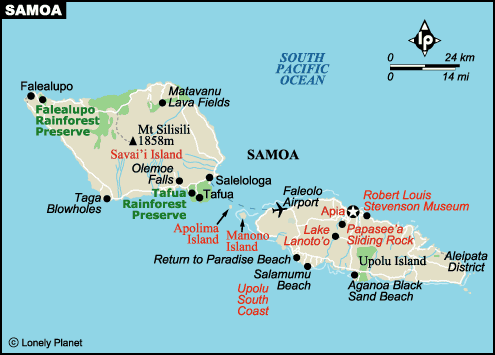
Samoa is about halfway between Hawaii and New Zealand, about 13 degrees south of the equator in the South Pacific, and 700 miles northeast of Fiji. There are two main islands, and several smaller ones, and it is often times confused with American Samoa. I will be in Apia, Samoa (Western Samoa), and the island is roughly the size of Rhode Island. American Samoa and Western Samoa are two completely different countries. It is their summer there, so it is going to be very hot.

Written on Saturday, February 11, 2006
I arrived in Samoa (Western Samoa) 2 weeks ago in a TINY 16 seater airplane... which held 13 of us and two Samoans... in a huge storm. But we made it here fine and it's been POURING the entire two weeks nonstop. Seriously, I've NEVER seen this much rain in my life. The amount of rain that Samoa has had in the last couple of weeks amounts to the normal yearly rainfall. Crazy. But the sun came out today... and it's absolutely beautiful. I'm staying at the University of the South Pacific in Alafua and I have 2-3 hours of the Samoan language every day, and during the rest of the day we have activities.

For instance, the first day we got here we did a drop off, which meant we all piled into Jackie's (our academic director... our teacher) van and she drove all over the side/back roads... "here's a nice mango tree!" and kicked us out of the van and let us fend for ourselves individually for an afternoon and we had to find Apia. It was terrifying, but totally worth it at the end. I met some nice people and I know know Apia like the back of my hand. The next day we did a similar thing, but we had to get on a bus individually and ride it around for awhile, find a random village, get off, and find your way back to Apia.

The buses here are NOT anything like the US buses, they're loud, colorful, LOADED with people (it's not unusual to have a few Samoans sitting on your lap) and has the bare minimum. And it was pouring. I wasn't quite sure how to stop the bus... some people tapped quietly on the window and GOD knows how the bus driver heard it, because they play their music so loud. About an hour into the bus ride, someone finally got off and I did too... and because it was raining so hard, nobody was out walking around. Palagi (pronounced Palangi) is the word for white people, so we hear that a lot. Especially in combination with "hahahahahahah palagi!" when it's raining and everyone is safely inside their fales (houses without doors, walls, or, well, anything. They're really cool, everyone lives in them) and there's a white girl wandering out in the rain by herself.
Anyway, I met a nice boy who helped me flag down a bus, and I managed to get back into Apia. We go into town a lot, shopping at the markets and hanging out at the bars (there's not much to do in Apia) and when it's sunny, like today, we go to the water. We're going to Piula Deep after I send this email... it's so hot and sunny today! We visited the Robert Louis Stevenson museum yesterday... it was cool. We also went to one of the seven only Baha'i temples yesterday too, and it was up in the mountains and so beautiful. Apia is a VERY small town, and most people are starting to recognize us. We met up with a bunch of the Peace Corps volunteers last night, and they're going to be a huge resource when ISP (our big paper) comes around... I met a woman from the states who said she'll hook me up with a school to work at. I'm really excited.

The rain, as I said before, has been super intense, and everything has been flooding like mad, so we've had to stay indoors... mostly at restaurants and bars and grocery stores.... but it makes for a lot of interaction. It's been interesting to see how Apia is SO small that people recognize us everywhere we go. Like I said I'm living at USP and there are roughly 100 students from all over the South Pacific. There are 4 girl houses, where we live, and six rooms in each house. They're very basic, but luckily I got a corner room with more windows because it's HOT. One of my roommates is from my SIT group. The other three are from Fiji... Sera, Sara, and Tia. A girl named Emali lived with us briefly but moved to the other house. Sera is wonderful, the second I met her she was very friendly and helpful, and I'm so thankful that the girls are my housemates. Tia is very funny and loud, and Sara is a first year. She's pretty shy, but she came out with us last night and we had a good time.
 Emali, Tia, and I
Most of the houses here are called fales, basically a concrete floor with posts, and a roof. No walls, and very little belongings. Since at the moment we're at the school, we have a more western-looking house and it's divided into bedrooms. Our houses sit in an AMAZING landscape... there are mountains behind us and the ocean down the Hill, and the fog makes everything incredibly wonderful. There's a river and a coconut plantation behind us, and because USP is an agricultural school, there are even cows in my own backyard. It can't get any better than that.
We'll be leaving Alafua (that's where USP is) on Wednesday or Thursday and going to Lotofago, my AD's late husband's family's village, where we will be staying for our homestay visit. They don't speak English, there aren't any showers (haha there is NO hot water at USP... very cold showers every day), and everyone sleeps in open fales on fine mats on the floor. It's going to be an awesome experience, and I'm excited. I need to beef up on my Samoan.
Some of the boys that sell ulu's (lei's) at night in town. Kiki, my little pal, is on the left. We became good friends.

Anyway, hope I haven't bored you... there are 9234879328474 other things I've left out, but I've passed the 2 1/2 week mark (that's how long it takes me to adjust to a new place) and I'm learning to call Samoa my new home. :) Though before I left, people were telling me that this would be a vacation, that I'd just be at the beach etc etc. While it is very tropical and beautiful, Western Samoa is not build up for tourists (they get something like 15,000 a year). There are LOTS of problems and issues, poverty and bad social structure and a not-so great education system. So I have my work cut out for me here, to explore and learn and get involved. Hope you're all doing well, thanks for the birthday wishes (I turned 21 on Tuesday) and the emails!
Written on Monday, March 13, 2006
I think last time I wrote, it was before my home stay. We spent 10 days in the village of Lotofaga, on the other side of Upolu (the island I'm on). O lo'u aiga Samoa. My Samoan family was made up of two older brothers, Kuka and Vilamu, a younger sister Gaupule, the mom, Sina, and the grandma (little) Gaupule. We (the 12 SIT kids) took the 2 hour bus ride to Lotofaga and were welcomed by the Women's Komitee, a few matai's, chiefs, and orators. We had a traditional 'ava (kava) ceremony and were presented with a gigantic lunch made by the women. THe amount of food they give to guests is UNREAL.

After wards, we were introduced to our families. Sina gave me a beautiful lei and we walked up to her house. It was very hot and we sat and looked at her pictures. She didn’t speak more than a handful of English words, so it was a lot of pointing and smiling. Gaupule, my grandmother is about 80 years old and I couldn't understand a WORD she said the entire stay. At the time, I didn’t think she liked me very much. I didn’t meet my two brothers until later, they weren’t really introduced to me, but I figured it out on my own. Kuka was the younger one, he was 20, I think. Viliamu was my older brother, 24 or so, and he was very sweet. We didn’t hang out much, but he brought me a necklace from Apia and he was very kind.
Interject the house: it was an open fale with a “palagi extention.” More like a fale with some wood in the back with a roof. It was very open and I was surprised to see that the ground was made of rocks. There were four chairs and a bunch of suitcases around the perimeter and I assumed that all the houses were like that, until I walked around and realized I got the short end of the stick house wise (or so I thought, because I wouldn’t have traded it for anything by the end of the week. You get an amazing view of the stars, the BEST view of the ocean, a nice breeze, and it’s very homey).

The first day we were there, everyone went to the beach with their palagis. I brought Sina and Gaupule and we hung out there for several hours. The children were awful… they were like the kids in Lord of the Flies, complete with a mud war, jumping out of the jungle, and attacking the palagis. The girls were kind of rude and made some inte! resting comments, and when we went back to the house, I was a bit overwhelmed. I needed to use the bathroom and wanted to take a shower, but I wasn’t quite sure how to go about it. Sina, as she did several times throughout the trip, read my mind and pointed outside and told Gaupule to come with me. I brought a change of clothes, soap, shampoo, and a towel out to the shower. Sina gave me a funny look as I walked out the door. Turns out, the “shower” was a bucket with some interesting colored water that dripped out of a pipe. It also faced the part of the house where my brothers slept. Awkward. I did the best that I could and realized there was no way I could actually get clean or change, so I wandered back into the house, soaked. Sina laughed at me and set up 3 curtains… but I was definitely exposed to a large area. I changed the best that I could without exposing myself, and eventually got dressed.

It was time for my first meal. I sat on the floor and had some sort of fish and taro mixture and thankfully, Sina ate with me. The only times during the week that meals were awkward was towards the end when there were more cousins around, I realized that Viliamu was eating my leftovers, so I didn’t eat very much and left the good stuff for him. The first time it happened, I didn’t realize that he would be eating what I didn’t, and I picked out all the potoatoes and good looking stuff. I felt horrible afterwards and changed my ways. After the meal, I still had to use the faleuila really badly and Sina read my mind and pointed outside, again. Gaupule followed me out there and thank God I brought a flashlight, because I couldn’t see anything. I went inside and positioned the “door” so that I had a bit of privacy and looked around with my flashlight: it! was interesting. I got out of there as fast as I could and vowed never to go back. I’m all for camping, and I figured if I could handle an Indian toilet, I could handle a Samoan one, but it just wasn’t going to happen. I hate to sound like a snob, but it was an embarassing situation.
We had a few days with our familes without class, and they were very slow. The language barrier was kind of intense, and it wasn’t until Sunday night or so that it got better. I had bought some language games in Hawaii and I had a few cousins that came around every night, so we played lots of shadow puppet games, hand games, and language games. Saturday night, I ended up "babysitting" and that’s what we did and I had a really good time. That’s when I met my cousin Fa’afoi, who became my savior throughout the week. Her intuition and judgem! ent of the people around us was incredible… she knew which guys were “yucky” and which ones were alright. There were a few men that came around that Fa’afoi saw and she would yell “Kiki! Go inside! Yucky boy!” and we’d go inside and wait until the creepy guy went away. It was really amusing. She also spoke the best English out of anyone in the family, so it was easier to communicate with her.
We did several arts/food things, and we helped make a fine mat. We also watched them prepare the umu, the cooking stove. We killed a pig (well, Uili (willy) did) with a stick and then they gutted it right in front of us. As a strong vegetarian of many many years, it was super intense, but I have to admit that it was really interesting to watch the amount of work that goes into food preparation.

There are these things called a "fiafia" and basically is a talent show that they give us gifts and we dance and sing and do the Samoan SaSa, a tradi! tional dance with hand slapping and clapping. The fiafia on Friday was really embarrassing, but totally worth it. We got all dressed up and danced around and had a really good time. It was fun watching our moms dance and jump around, and have our cousins and siblings laugh at us. Nika and I sang "Boogie Woogie Bugle Boy" complete with dancing and acting, which I hadn’t done in awhile, and it was really fun. I was very overwhelmed by how many gifts the women’s committee gave us. It was incredible: we ended up with something like 40 lavalavas, 20 purses, 10 wallets, tons and tons of jewlery, and other things.
The last morning I spent with my family was rough. I hadn’t slept much and I was bummed to be leaving my family. They made me another lei, which marked 10 since I had arrived. They also gave me a hair clip and Viliamu gave me a necklace. The night before I had given them my gifts and we had a good time playing with the blow pens/markers deep into the night. My extended family came over and we said goodbye and while we were eating breakfast, Sina started crying. It was so sad, she was so sweet. She kept telling me to come back to Lotofaga and she was crying. We walked over to Jackie’s house and sat in a fale across the way for awhile out of the rain, and then we all started piling into the van. Sina was holding my hand and started crying again. She was so nice and so sweet. Even though the family didn’t have any money, they were rich in my eyes. I couldn’t believe how uncomfortable I had been in the beginning of the trip, and how much I had bonded with someone who couldn’t speak my language. It was very touching. When I first met the older Gaupule, I thought she was annoyed by my presense, but throughout the week we gained a quiet friendship. We never talked, but she made me leis, helped me hang my mosquito net, and the very last day I was there, she put on the nicest clothes I had seen her in the entire trip and combed her hair and asked me to take a picture of her. She was absolutely beautiful and I caught a glimpse of what she must have been like in her younger years. After, we took a "family portrait."

We piled into the van and drove back to Apia, which was hustling and bustling, and I loved being back… for about an hour. After a shower (which I badly needed) and some time with the pod (ipod), I was ready to go back to Lotofaga. I missed it already!
We came back to Apia for a few days, and then left for Savai'i, another island of Western Samoa. It's the third largest polynesian island. It's also not as inhabited. It was absolutely beautiful... the first couple of days we stayed in beach fales 10 feet away from the ocean. My friend Caitlin and I liked it so much that we went back at the end of the week.


During the week, we stayed in Safua and went around the island with a guy named Warren and his friends. We hiked a! LOT, in and around craters, on lava fields, star mounds, waterfalls, beaches, you name it. We saw the flying fox (several of them), both the regular one and the one native to Samoa that America doesn't think exists. But I saw it with my own eyes, it's here and alive. We also made our own tapa cloths... you take a mulbery tree that's about 5 feet tall and an inch wide and you skin it, beat it, scrape it, and it gets about 20 times the original size and dry it, paint it with colors from the bark of the tree, and dry it. It was really fun! We also went hiking around the sea cliffs and around this blowhole. Two guys put coconuts in them and we watched them shoot a hundred feet in the air!
 The only bad thing that happened was that Caitlin, Kelly, and I got all of our money stolen. We had left it in our locked room during dinner and when we got back it was gone. Nearly 1000 tala. Boo. At least the scenery was pretty.
Other than that, I have been learning lots about Samoa. We are located near Apia, which is the ONLY developed town in all of the islands of Samoa, and have been faced with the realities of alcoholism, violence, and living in a small town. Everyone knows who we are, as we're the resident palagis... so we stick out. One of the boys in the group was unfortunately beaten up by some drunk Samoan men because he went off by himself and they wanted his money because he's palagi. He got beated pretty bad, and had to go to the hospital, but he'll be alright. Also, the other boy in our group, his host mother died this past weeked due to domestic violence. It's just a reminder that although it may seem like paradise sometimes, there is a harsh reality to living in the culture that we're in. Of course, you have to take it with a grain of salt, because the majority of the people we have befriended and met are really quite nice. The reactions of the townspeople (as we are Palagi, even the head of the parliment found out... news spreads FAST) regarding Will was that they hoped our view of Samoa wasn't hurt and that the village would have to apologise... one of the customs here. THe village takes responsibility of what happens, rather than an individual to some extent.
But Samoa continues to amaze me every day. It's a really rough lifestyle, contray to popular belief, but it's something so different than I could have ever imagined. I'm already getting sad that I have to leave in a month and a half, I've pretty much decided to extend my trip either here, Tonga, or New Zealand. We'll see, but coming back to the states isn't something I'm ready to do anytime soon. There is so much rich culture and things to learn, see, do, people to meet, that the very thought of leaving is overwhelming.
Written on Thursday, April 13, 2006
I think the last time I wrote was a month ago when I got back from our homestays and Savaii. Since then we have traveled to American Samoa and Fiji, finished up our classes, and began our ISP (independent study projects).
American Samoa was definitely an eye-opener. A quote from a member of our group kind of describes some of it: "It's like they ended up with all the filtered crap from America" and that's partially true. The island itself is MUCH more beautiful than Western Samoa. It has beautiful mountains and is much smaller. However, the influence of rap, McDonalds, and thug-nation has infiltrated the culture and many of the Samoans we talked to were ashamed to be Samoan and wanted to be "whiter" which suprised me. However, I found American Samoa to be beautiful. The plan was to stay with students from the college, because we were attending classes at Samoa Community Collegeso, and that way we'd be with people our age. However, my "student" was a 40 or so year old mom. At first I was a bit dissapointed, but changed my mind immediately after meeting her. I stayed with her very nice family in the village of Aua, kind of near Pago in the Harbor. The Harbor was beautiful, and my house overlooked it from the side of a mountain.
American Samoa was definitely an eye-opener. A quote from a member of our group kind of describes some of it: "It's like they ended up with all the filtered crap from America" and that's partially true. The island itself is MUCH more beautiful than Western Samoa. It has beautiful mountains and is much smaller. However, the influence of rap, McDonalds, and thug-nation has infiltrated the culture and many of the Samoans we talked to were ashamed to be Samoan and wanted to be "whiter" which suprised me. However, I found American Samoa to be beautiful. The plan was to stay with students from the college, because we were attending classes at Samoa Community Collegeso, and that way we'd be with people our age. However, my "student" was a 40 or so year old mom. At first I was a bit dissapointed, but changed my mind immediately after meeting her. I stayed with her very nice family in the village of Aua, kind of near Pago in the Harbor. The Harbor was beautiful, and my house overlooked it from the side of a mountain.

I stayed with a couple named Ted and Rachel (Rachel was my "student"), thier two children and two nieces (one niece was about 19, so a bit closer to me in age). The family is very religious and most everyone on Rachel's side of the family is either a pastor or married to one. It was so nice to be in a christian household and have prayer and bible study each night. The family was the kindest, most giving family ever. With some of the other students, we hiked up a mountain to see the view one day, and spent another day purely with our families. My family was very sweet and I was sad to leave them. It was definitely a culture shock after being in Western Samoa... It was hard to believe that the two islands are only separated by 70 miles of ocean, yet the differences are so vast.
My house in Lotofaga (the village stay in Upolu), if you remember, had the bare minimum and the family didn't have any money. My family in American Samoa, however, lived in a brand new four bedroom house with leather couches, cable, two cars, air conditioning, and a computer with internet, and gave me 40 dollars at the airport after I was leaving (and a pulatasi... traditional Samoan dress for women. you should see it... it's awesome!). Very different, very palagi. I went to church with them on SUnday and it was incredible... it was a Pentacostal church and the music was absolutely amazing. It brought me to tears.

We came back to Samoa for a week and then left for Fiji. For the first few days, we stayed in a village called Amaca (pronounced ambatha). Again, I had a very nice family. Kilisi, my host mom, was so sweet and we had some really good conversations. I was doubled up with my teacher, and we had some really good conversations as well. The village stay was pretty similar to the one in Lotofaga, but it was Fiji (obviously). THe houses were different but a lot of the custums were the same. We had several kava ceremonies and boy, can the Fijians drink! Kava isn't an alcholic beverage, it's from a root but it produces a numbing effect that makes you very sleepy. Fijians drink it ALL the time. We had a good time singing and sitting with the Fijians and again, were sad to leave. We left the same way we came... as Samoan refugees ;) We all piled up into the backs of two small pickup trucks that had the backs covered and sped down a bumpy dirt road at 50mph with UB40 blasting and looking at the most amazing scenery.

We drove 5 hours to the capitol city of Suva (in a bus) and spent the remainder of the time in Fiji there (about a week). There was an SIT group in Fiji and we had lectures with them at thier USP campus, which was about 10 times the size of Chapman and 30 times the size of our USP campus in Alafua (Samoa). It was intense. We had some really interesting lectures and overall had a good time. The SIT fiji kids are definitely having a different experience than we are, but it was good to see what it would be like living in a huge city: Suva is gigantic compared to Apia. Caitlin and Jessica and I walked almost all of Suva... the indian parts (which reminded me of being in India... oh the food is so good!), the fijian parts, the american parts... we checked out the markets, hole-in-the-wall stores, and ate some really good fijian and Indian food. We took part in a dance show with the other SIT Fiji kids (who did a traditional Fijian fan dance) by doing our Samoan SaSa, and we watched a group of indian dance students put on a show. It was so great! I was kind of glad to leave Suva though, it was a bit intense: very polluted, populated, and busy. We left Suva on a Saturday morning and stopped in Navua for a river boat ride to see a waterfall and a village. We then made the 4 hour drive back to Nadi (to the airport) and stopped at Pram's (our bus-driver) house for dinner, which was the best Indian food I'd had on this trip by far. He was very sweet and told us anytime we wanted to come back to Fiji, we could stay w/ith him.
As we were driving back, we saw the very first sunset of the day, and as we flew back to Samoa, we saw the very last sunrise and sunset of the day in the world, all on April 1st (Jess, I celebrated your birthday twice!) because of the date line.

Since then, we've finished up classes. We had our Pacific Studies Class final (the only class that actually counts for me at Chapman) on wednesday and I aced it... woo! We started our ISP period last week. I am working at Samoa Primary School in Vailele... it's a private school that's only been around for three years but has very experienced teachers. I've been working there all week and I absolutely love it! The kids are so fun and attentive, and so respectful and obedient. There are some major differences from the American school system though. I will be writing my paper (40 pages, eek!) next week while they're on Easter break and then will go back a week after that.
*insert future note: While I was working at the school, I felt like I really was part of Samoa. Not just part of the Palagi that were there. I took the same bus as the kids to get there, spent all day with them, and then rode back to Apia with them. I walked through the streets and I'd hear, "MALO Ms. KIKI!" From the backs of trucks, and have random people come up and talk to me and they knew my name. It was very touching.
This weekend for Easter, I was invited by one of the teachers at the school to come home to her family with her to Laumanu... the most beautiful beach on the island. Also, I checked out Sliding Rock and it was pretty sweet.... it's natural waterfalls that have carved and smoothed out the rocks so you can slide down them like a waterslide. Fun!

This weekend for Easter, I was invited by one of the teachers at the school to come home to her family with her to Laumanu... the most beautiful beach on the island. Also, I checked out Sliding Rock and it was pretty sweet.... it's natural waterfalls that have carved and smoothed out the rocks so you can slide down them like a waterslide. Fun!
Written on Monday, 15 May 2006
Malo Soifua everyone!!!
I'm officially back in America at my parent's house in Auburn. We said a sad goodbye to our friends and the island last Sunday and flew back to the states.
We finished up our independent study projects, papers, and presentations, and returned to the village for one last goodbye to our host families. It was a nice visit and my family was very excited to see me and vise-versa. I spent the last couple of days in Samoa visiting friends and saying goodbye, I made some really good friends (especially at USP) and it was very hard because it's very unlikely that we will see each other again. But as the Fijians say it, "see you when we see you." One girl is already planning a return trip.
After saying farewell, we drove to the airport and took a tiny plane to American Samoa, had a eight hour layover, and flew to Hawaii where my SIT group said goodbye and one girl was detained because they thought she had rabies... she got bit by a dog. But she seems to be okay, so no worries. I spent the day in Hawaii, trying to re-adjust to America and had a hard time... so I locked myself up in my hotel room and journaled. It was definitely reverse culture shock... and it was FREEZING. I turned on the heater in my room because I was so cold. There's NO humidity in Hawaii and California, it seems like. People were looking at me like I was crazy when I was wearing a sweatshirt.
I flew home to Sacramento and was greeted by my family and a few friends and it was wonderful to see them. I've been home for a week now, and things seem to be getting back to normal for the most part. It's a very difficult adjustment from a VERY difficult semester.
I'm officially back in America at my parent's house in Auburn. We said a sad goodbye to our friends and the island last Sunday and flew back to the states.
We finished up our independent study projects, papers, and presentations, and returned to the village for one last goodbye to our host families. It was a nice visit and my family was very excited to see me and vise-versa. I spent the last couple of days in Samoa visiting friends and saying goodbye, I made some really good friends (especially at USP) and it was very hard because it's very unlikely that we will see each other again. But as the Fijians say it, "see you when we see you." One girl is already planning a return trip.
After saying farewell, we drove to the airport and took a tiny plane to American Samoa, had a eight hour layover, and flew to Hawaii where my SIT group said goodbye and one girl was detained because they thought she had rabies... she got bit by a dog. But she seems to be okay, so no worries. I spent the day in Hawaii, trying to re-adjust to America and had a hard time... so I locked myself up in my hotel room and journaled. It was definitely reverse culture shock... and it was FREEZING. I turned on the heater in my room because I was so cold. There's NO humidity in Hawaii and California, it seems like. People were looking at me like I was crazy when I was wearing a sweatshirt.
I flew home to Sacramento and was greeted by my family and a few friends and it was wonderful to see them. I've been home for a week now, and things seem to be getting back to normal for the most part. It's a very difficult adjustment from a VERY difficult semester.
I've made a short list of things one gets used to living in Samoa just so you can kind of get an idea what it was like:
1. People always ask where you're going and if you want tea
2. Giant centipedes, millipedes, lizzards, snails, cockroaches, and dogs are EVERYWHERE.
3. You have to be careful with the dogs because they bite and they're super mangy
4. It's a process to get water... either boil it and let it cool, use iodine tablets that taste awful, or filter it, each of which takes awhile.
5. It's a process to get food... there was one denpoo between the 12 of us and we bought food at the maketi.
6. The people on campus are so interesting... there are people from ALL over the South Pacific and they have such different cultures.
7. You get used to being dirty and not doing laundry... ever. And the rare times you do... hand wash baby!
8. Hot water doesn't exist. You get really used to the freezing cold showers.
9. Samoa, while absolutely beautiful... is a developing country and i guess not technically considered a third world because there is enough food and whatnot... but otherwise is very much a third world country.
10. The hospitality is amazing... everywhere you go people offer you whatever they have, even if they can't really afford to give it: in samoa, wealth is not measured by how much money you have, but by how much you can give in any other aspect.
11. It's a very small country... and with only one developed city, where everyone knows you or knows of you. I'd be walking through the maketi and someone would yell out, "hi kiki!" and you see people you like and people you dont like... so don't burn too many bridges.
12. The idea of a healthy diet is non-existent... it was very difficult to get good nutrition and many people got sick because of it. We ate a lot of turkey tails and mutton flats because it's the parts that Americans don't want that gets shipped to countries that cant afford to buy anything else. They also eat a lot of starch and not enough fruits and vegetables. But I ended up eating fish 3-5 times a week, which was interesting because i Hated fish before the trip.
13. Being able to hear, speak, and understand the Samoan language was one of the most valuable parts of the semester. I enjoyed this aspect very much and LOVE the language. I loved being around so many different languages: Samoan, Fijian, Tongan, and several other languages. 14. You learn to love and thrive on Rugby games... several weekends were spent with the Fijian and Samoan rugby teams that were playing in the South Pacific Cup while we were there because many of the Fijians on campus have friends/relatives on the teams. It was a blast.
15. People break into song and dance at the oddest moments... and it's absolutely incredible. It was awesome to just be sitting around and someone would start singing, then everyone would join in and soon there would be thirty people doing some sort of impromtu show.
16. The terms "I love you" and "boyfriend" are NOT the same as in America... I had several marriage proposals while in Samoa :) Unfortuantely I had to turn them all down ;)
17. It's not uncommon to wake up and open your door to thirty fijians eating breakfast in our common room that about 10x10 feet.
18. Although it's an island and the ocean is so close, I can count the number of times I went to the beach on one hand... and almost all of the time you have to wear a lavalava and a tee-shirt. Bathing suits by themselves are not kosher.
Now that I'm home, Samoa feels like a dream, a blink that went by in a moment. This is the never-ending summer and I look back at Samoa as something totally out of the ordinary. It's very hard to sit in my house with my computer with my air conditioner with my car sitting in the driveway and talk to my white friends and not miss the colors, the smells, the heat, the beautiful brown faces, the loud laughter that rang through the air like church bells on Sunday mornings, the friendships I made with some truly incredible people who will never be able to afford to come to America, drinking tea with roommates and friends, singing songs, meeting new people, constantly being watched and having people approach you and ask questions about your life, and the fa'asamoa... the samoan way of life. I have come home hardened in many ways, but warmed in others. I am very appreciative of being able to go on such an adventure. It was challenging, it was difficult, it was eye-opening and it was beautiful, and I can't believe that just a week and a day ago I was still there, but I'm so glad to be with my friends and family again. It's taking some time to get used to only seeing one type of person, re-learning how to use my cell phone and drive my car, and walking into any type of grocery store or Target is super-overwhelming, but I have gained a new sense of appreciation for different things.
Fa soifua ma fa'afetai lava
1. People always ask where you're going and if you want tea
2. Giant centipedes, millipedes, lizzards, snails, cockroaches, and dogs are EVERYWHERE.
3. You have to be careful with the dogs because they bite and they're super mangy
4. It's a process to get water... either boil it and let it cool, use iodine tablets that taste awful, or filter it, each of which takes awhile.
5. It's a process to get food... there was one denpoo between the 12 of us and we bought food at the maketi.
6. The people on campus are so interesting... there are people from ALL over the South Pacific and they have such different cultures.
7. You get used to being dirty and not doing laundry... ever. And the rare times you do... hand wash baby!
8. Hot water doesn't exist. You get really used to the freezing cold showers.
9. Samoa, while absolutely beautiful... is a developing country and i guess not technically considered a third world because there is enough food and whatnot... but otherwise is very much a third world country.
10. The hospitality is amazing... everywhere you go people offer you whatever they have, even if they can't really afford to give it: in samoa, wealth is not measured by how much money you have, but by how much you can give in any other aspect.
11. It's a very small country... and with only one developed city, where everyone knows you or knows of you. I'd be walking through the maketi and someone would yell out, "hi kiki!" and you see people you like and people you dont like... so don't burn too many bridges.
12. The idea of a healthy diet is non-existent... it was very difficult to get good nutrition and many people got sick because of it. We ate a lot of turkey tails and mutton flats because it's the parts that Americans don't want that gets shipped to countries that cant afford to buy anything else. They also eat a lot of starch and not enough fruits and vegetables. But I ended up eating fish 3-5 times a week, which was interesting because i Hated fish before the trip.
13. Being able to hear, speak, and understand the Samoan language was one of the most valuable parts of the semester. I enjoyed this aspect very much and LOVE the language. I loved being around so many different languages: Samoan, Fijian, Tongan, and several other languages. 14. You learn to love and thrive on Rugby games... several weekends were spent with the Fijian and Samoan rugby teams that were playing in the South Pacific Cup while we were there because many of the Fijians on campus have friends/relatives on the teams. It was a blast.
15. People break into song and dance at the oddest moments... and it's absolutely incredible. It was awesome to just be sitting around and someone would start singing, then everyone would join in and soon there would be thirty people doing some sort of impromtu show.
16. The terms "I love you" and "boyfriend" are NOT the same as in America... I had several marriage proposals while in Samoa :) Unfortuantely I had to turn them all down ;)
17. It's not uncommon to wake up and open your door to thirty fijians eating breakfast in our common room that about 10x10 feet.
18. Although it's an island and the ocean is so close, I can count the number of times I went to the beach on one hand... and almost all of the time you have to wear a lavalava and a tee-shirt. Bathing suits by themselves are not kosher.
Now that I'm home, Samoa feels like a dream, a blink that went by in a moment. This is the never-ending summer and I look back at Samoa as something totally out of the ordinary. It's very hard to sit in my house with my computer with my air conditioner with my car sitting in the driveway and talk to my white friends and not miss the colors, the smells, the heat, the beautiful brown faces, the loud laughter that rang through the air like church bells on Sunday mornings, the friendships I made with some truly incredible people who will never be able to afford to come to America, drinking tea with roommates and friends, singing songs, meeting new people, constantly being watched and having people approach you and ask questions about your life, and the fa'asamoa... the samoan way of life. I have come home hardened in many ways, but warmed in others. I am very appreciative of being able to go on such an adventure. It was challenging, it was difficult, it was eye-opening and it was beautiful, and I can't believe that just a week and a day ago I was still there, but I'm so glad to be with my friends and family again. It's taking some time to get used to only seeing one type of person, re-learning how to use my cell phone and drive my car, and walking into any type of grocery store or Target is super-overwhelming, but I have gained a new sense of appreciation for different things.
Fa soifua ma fa'afetai lava
November 28, 2007
It's been over a year and a half since I returned from Samoa and I still think about it often. I talk with one or two people from my group, and I have kept in regular contact with a few friends from Samoa who still live there, or went back to Fiji. One of the reasons Jess and I are going to Australia is because I miss the South Pacific. Hopefully I'll get to visit Samoa on the way there or on the way back, money and time depending. But I'd love to see my host family and friends and teacher again. hope hope hope!


